
Spray Foam Roofing in Maryland
Seamless, fully-adhered spray polyurethane foam (SPF) roofing that insulates, waterproofs, and adds structural strength to low-slope commercial roofs.
A Seamless, Energy-Efficient Roof
Spray polyurethane foam is applied as a liquid that expands into a solid, monolithic layer — conforming to every penetration and detail with no seams or fasteners for water to find. As the original “Foam” in Bel Air Foam & Roofing, spray foam roofing has been part of our work for decades.
Superior Insulation
High R-value per inch helps reduce heating and cooling costs across the life of the roof.
Seamless & Watertight
A monolithic membrane with no seams or fasteners means far fewer points of failure.
Lightweight & Strong
Adds strength and rigidity to the roof deck while adding minimal weight to the structure.
Renewable Over Time
Periodic recoating renews the protective surface and extends service life for decades.
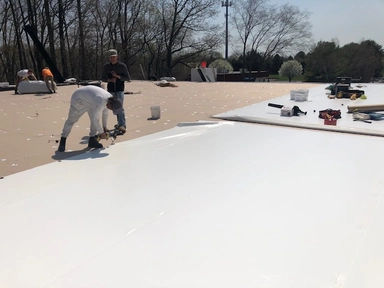
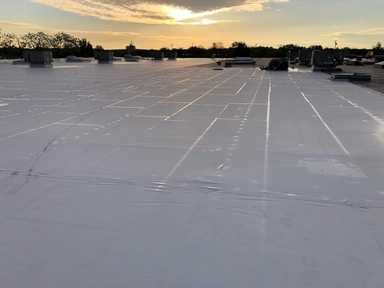
Spray-Applied Roofing in the Field
Considering a Spray Foam Roof?
Tell us about your building and we’ll recommend the right system — SPF, Duro-Last® PVC, or a repair. Fast, free estimates.
How Spray Foam Roofing Works
Spray polyurethane foam (SPF) roofing is a fluid-applied system, not a sheet or panel product. Two liquid components—an isocyanate and a resin—are metered, heated, and combined at the spray gun, where they react and expand roughly thirty times in volume within seconds. Applied directly to a properly prepared substrate, the foam cures into a rigid, closed-cell membrane that conforms to every curb, penetration, drain, and parapet on the roof.
Because the foam is sprayed as a continuous monolithic layer, there are no seams, laps, or fasteners—the traditional entry points for water on a commercial flat roof. Once the SPF reaches the specified thickness, our crews apply a protective elastomeric coating, typically silicone or acrylic, followed by an embedded granule surface for UV resistance and walkability. That coating is the sacrificial, renewable layer that shields the foam from sunlight and weather for decades.
Insulation, R-Value, and Energy Performance
Closed-cell SPF is one of the highest-performing insulation materials available for a roof assembly, delivering roughly R-6.5 per inch of thickness. A standard installation of two to three inches produces a continuous, thermal-bridge-free blanket across the entire building envelope—something layered board insulation with mechanical fasteners cannot match. The result is measurably lower heating and cooling loads on the building.
- Continuous insulation: no gaps at board joints or fastener heads where heat escapes.
- Air and moisture barrier: the closed-cell structure resists air infiltration and vapor drive.
- Reflective top coat: a bright silicone or acrylic surface reflects solar heat, reducing rooftop temperatures and HVAC demand.
For facility managers tracking utility spend across a large footprint, the combined insulating and reflective effect of an SPF roof often produces energy savings that offset a meaningful share of the installed cost over the system’s life.
Ideal Applications for SPF
Spray foam is not a fit for every building, but on the right structure it outperforms alternatives. SPF excels on large flat and low-slope commercial roofs where seamless waterproofing and added insulation deliver the most value—warehouses, manufacturing plants, distribution centers, schools, retail centers, and institutional buildings.
Two characteristics make SPF especially attractive. First, it is lightweight, adding only a few ounces per square foot, so it rarely requires structural reinforcement. Second, its self-flashing, conforming nature makes it the strongest option for roofs cluttered with HVAC units, pipe penetrations, skylights, and irregular geometry that would otherwise demand extensive hand-detailing. On roofs with positive drainage problems, SPF can also be tapered during application to build slope and eliminate standing water without a costly tear-off.
Recoat and Maintenance Cycle
An SPF roof is designed to be maintained and renewed rather than replaced. The foam itself is durable and stable; it is the top coating that weathers over time. On a typical schedule, the elastomeric coating is inspected regularly and recoated roughly every 10 to 15 years, depending on the coating type, thickness, and environmental exposure.
When the time comes, a recoat is straightforward: the surface is cleaned, prepared, and a fresh coat of silicone or acrylic is applied over the existing foam. There is no tear-off, no landfill waste, and minimal disruption to operations below. Each recoat effectively restarts the warranty clock, which is why a well-maintained SPF roof can remain watertight for 40, 50, or more years—making it one of the lowest lifecycle-cost roofing systems in commercial construction.
Choosing SPF Versus Other Commercial Systems
Every roof deserves the right system, and part of our job is telling you honestly when SPF is—and isn’t—the best choice. SPF is the clear winner when your priorities are maximum insulation, seamless waterproofing, and a renewable system that avoids future tear-offs, particularly for reroofing over a structurally sound existing roof.
Where a single-ply membrane such as Duro-Last® PVC may be preferable—for example, on projects requiring a factory-fabricated warranty package or specific chemical resistance—we will say so. As a full-service commercial contractor, Bel Air Foam & Roofing installs both, so our recommendation is driven by your building’s needs rather than a single product line. A rooftop evaluation, moisture survey, and discussion of your operational goals give us what we need to specify the correct assembly.
Frequently Asked Questions
How long does a spray foam roof last?
With a proper maintenance and recoating program, an SPF roof can remain watertight for 40 to 50 years or more. The foam itself is highly durable; only the protective top coating is periodically renewed, so the roof is never fully replaced—just recoated to extend its service life indefinitely.
How much energy can a spray foam roof save?
Closed-cell SPF delivers about R-6.5 per inch of continuous, thermal-bridge-free insulation, and its reflective top coat lowers rooftop temperatures. Together these reduce heating and cooling loads across the building envelope, and many commercial facilities see meaningful reductions in HVAC energy use over the life of the roof.
What does recoating an SPF roof involve?
Every 10 to 15 years the elastomeric coating is renewed. The surface is cleaned and prepared, then a fresh layer of silicone or acrylic is applied directly over the existing foam. There is no tear-off, no disposal of old materials, and each recoat restarts the warranty period.
Can spray foam be applied over my existing roof?
In many cases, yes. If the existing roof is structurally sound and free of significant trapped moisture, SPF can often be applied directly over it—eliminating the cost, disruption, and landfill waste of a tear-off. We confirm suitability with a rooftop inspection and moisture survey before recommending a reroof.
How much does a spray foam roof cost?
Cost depends on roof size, foam thickness, coating specification, and the amount of surface preparation and detailing required. While SPF is competitive up front, its real advantage is lifecycle cost: because it is recoated rather than replaced and lowers energy bills, the long-term cost of ownership is among the lowest of any commercial roofing system. We provide a detailed written estimate after evaluating your roof.
Is a spray foam roof heavy enough to require structural changes?
No. SPF is one of the lightest roofing systems available, adding only a few ounces per square foot. It rarely requires any structural reinforcement, which is one reason it is so well suited to reroofing over existing assemblies without adding significant dead load.
Explore Our Commercial Roofing Services
Duro-Last® PVC Systems · Flat & Low-Slope Roofing · Commercial Roof Repair · Reroofing & Replacement. Serving Bel Air, Baltimore & the surrounding area.
Request a Free Commercial Roofing Estimate
Call 410-838-5900 or request your free estimate online — backed by 50+ years of commercial roofing experience.